Skip to content
The Golden Circle
Menu
  • ABOUT US
  • CONTENT
  • PRODUCTS
    • Nutritionals 
      • BiOmega®
      • Calm Response
      • CELLSENTIALS®
      • CopaPrime+
      • CoQuinone®
      • Digestive Enzyme
      • Hepasil DTX
      • MagneCal D
      • Palmetto Plus
      • Poly C® 
      • Probiotic 
      • Procosa®
      • Proflavanol®C
      • Proglucamune® 
      • Pure Rest
      • Usanimals
      • Visionex®
    • Celavive Skincare
      • Creamy Foam & Gentle Milk Cleansers
      • Perfecting Toner
      • Celavive Hydrating & Lifting Sheet Mask
      • Vitalizing Serum
      • Hydrating Eye Essence
      • Protective Day Cream and Lotion
      • Replenishing Night Cream & Gel
    • Personal Care
      • Whitening Toothpaste
    • Active Nutrition
      • Nutrimeal
  • CONTACT US
  • SEARCH

Layer by Layer: Understanding Your Skin’s Structure

Posted on by hesveymartin

About 15 percent of your body weight is skin. If that seems like a lot, remember that skin is your largest organ. And one of your most important. Understanding your skin’s structure is the first step to maintaining the health of your armor against the outside world.

The Purpose of Your Skin

Your skin comprises a large portion of the integumentary system. This organ system also contains hair, nails, and glands that produce sweat and oil. The three main functions of the integumentary system are protection, regulation, and sensation.

Skin’s primary function in this system is to act as a barrier. It provides protection from various environmental elements—temperature, bacteria, chemicals, the sun, and more. But the blood vessels in the skin also help it regulate your body temperature. And skin is where your body uses sunlight to manufacture vitamin D.

Layers of the Skin
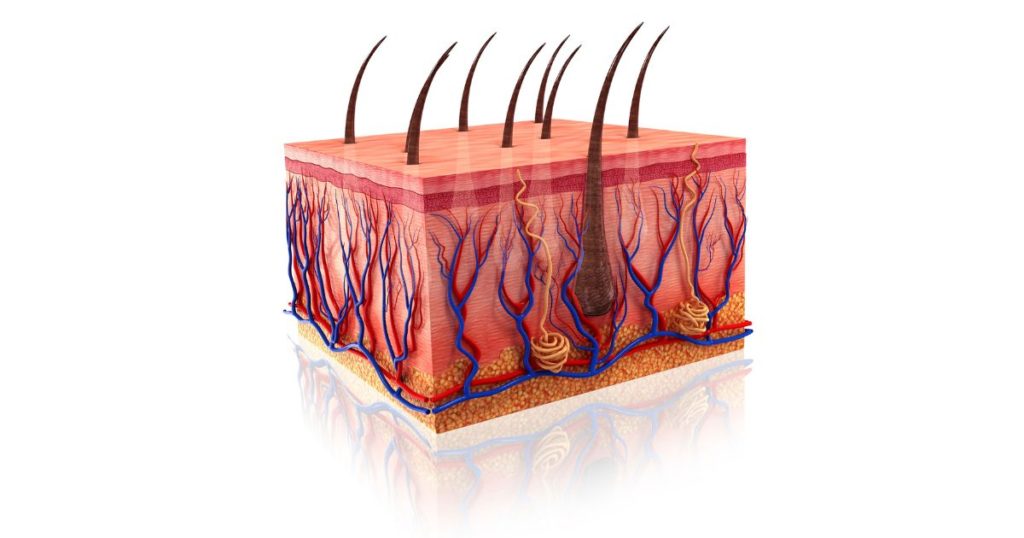
Your skin performs a lot of important functions, and each of its three layers play a role.

Epidermis

The epidermis is the top layer of your skin. It’s made up of millions of skin cells held together by lipids. This creates a resilient barrier and regulates the amount of water released from your body.

The outermost part of the epidermis (stratum coreneum) is comprised of layers of flattened cells. Below, the basal layer—composed of proteins in column-like arrangements—makes new skin cells. That’s because this layer is the only one of the epidermis’ five parts that perform mitosis (division of the cellular nucleus). So your older skin cells flake off the very top layer, and the newer ones push up from the basal layer to take their place.

Your epidermis contains four different types of cells. The majority are keratinocytes, which form your water-proof, protective barrier. Melanin—or skin pigment—is produced in the epidermal melanocytes. Langerhans and Merkel cells deal with immune response and sensation, respectively.

Dermis

The next layer of skin is the dermis. It lies beneath the epidermis, and is responsible for a variety of functions.

This layer contains hair roots, nerve endings, blood vessels, and sweat glands that help regulate body temperature and remove waste products. The dermis also contains oil (sebaceous) glands that keep your skin looking soft and smooth, but also help with waterproofing.

Your dermis has two parts—papillary and reticular. The papillary dermis contains the interlocking connections that help supply blood and nutrients to the epidermis. The reticular dermis is the thicker, deeper portion that contains building blocks like collagen and elastin which give skin its flexibility and strength. Your hair follicles and glands also reside in the reticular dermis.

Hypodermis or Subcutaneous Tissue

The subcutaneous tissue is the lowest layer of the integumentary system. It’s used mainly for fat storage. The hypodermis contains the connective tissue that attaches the dermis to your muscles and bones. It also provides support to the blood vessels, nerves, and glands in the dermis.

Key Elements of the Skin Matrix

The skin matrix is a collection of proteins, fats, and peptides that provide resilience and stability. Here are the main components of this support structure:

  • Elastin – protein that forms elastic connective tissue, found in the dermis
  • Keratin – key structural protein that makes up the outermost layer of the skin
  • Collagen – long-chain amino acid that makes up the majority of protein found in your skin
  • Lipids – the natural ‘mortar’ that helps lock in moisture and bind the cells together
  • Peptides – chains of amino acids that signal our cells to let them know how to function

The More You Know

Learning these basics will help you gain a greater understanding of how to take care of and maintain your skin properly. Now that you know the basics of your skin’s structure, learn more about the important role nutrients play in healthy-looking skin.

References
  • Baumann, L. “Skin ageing and its treatment.” The Journal of Pathology 211.2 (2007): 241-51.
  • Obagi, Suzan. “Why does skin wrinkle with age? What is the best way to slow or prevent this process?” Scientific American. N.p., n.d. Web. 28 July 2017.
  • “The layers of your skin.” American Academy of Dermatology, n.d. Web 28 July 2017
 

Was this helpful? If you were not able to find the answers you’re looking for, please send us your questions here and we’ll try to find the answers for you!

This article is a property of askthescientists.com and is posted in this website for educational purposes only. No copyright infringement is intended herewith.

FacebookTweetLinkedInPin
Posted in HEALTHY LIFESTYLE

Leave a Reply Cancel reply

Your email address will not be published. Required fields are marked *

Recent Posts

  • Metabolism – It’s What Keeps You Going
  • Nutrition on the Go: Fuel Your Body with Key Nutrients to Power Your Busy Life
  • Financial Secret Only 5% of People Know About
  • How To Have A Sustainable Change In Habits
  • Test Your Cognitive Skills to Find Out Your Mental Fitness
  • You’re 6 Minutes Away from a Better Understanding of Cellular Nutrition
  • More Motivation to Move: Exercise Benefits Beyond Weight Loss

Popular Stories Right now
The Science of Slumber: Sleep and Health 
Take a Deep Dive on the Body and Brain Benefits of USANA® BiOmega™
Tackle Your To-Do List with the Science of Self-Motivation 


Be Part of The Golden Circle Email List!

By submitting this form, you are consenting to receive email updates from: The Golden Circle, https://bethegoldencircle.com. You can revoke your consent to receive emails at any time by clicking the unsubscribe button at the buttom of each emails.
Loading


Featured Product

Celavive® Protective Day Cream & Lotion-Hydrate and protect your delicate facial skin with nourishing moisturizers and a broad-spectrum SPF 30 sunscreen


WHAT SHOULD I TAKE?

Do you want to know what are the supplements that you should take based on your current lifestyle, gender, diet, age, daily activities, and health priorities? Click the button below to take the advisor quiz that will guide you which USANA products are right for you powered by askthescientists.com. Or you can contact us directly for us to assist you personally.

TAKE THE ADVISOR QUIZ NOW
CONTACT US

LOOKING FOR AMAZING INCOME OPPORTUNITY?

If you want to have additional source of income in a moral, legal, and ethical way while becoming the better version of yourself and help others achieve their dreams as well, click the image below to know more about the amazing business opportunity of USANA and start building and achieving your dreams now!

To direct audience to landing page - USANA Business offer
Copyright © 2026 The Golden Circle – OnePress theme by FameThemes
We use cookies on our website to give you the most relevant experience by remembering your preferences and repeat visits. By clicking “Accept All”, you consent to the use of ALL the cookies. However, you may visit "Cookie Settings" to provide a controlled consent.
Cookie SettingsAccept All
Manage consent

Privacy Overview

This website uses cookies to improve your experience while you navigate through the website. Out of these, the cookies that are categorized as necessary are stored on your browser as they are essential for the working of basic functionalities of the website. We also use third-party cookies that help us analyze and understand how you use this website. These cookies will be stored in your browser only with your consent. You also have the option to opt-out of these cookies. But opting out of some of these cookies may affect your browsing experience.
Necessary
Always Enabled
Necessary cookies are absolutely essential for the website to function properly. These cookies ensure basic functionalities and security features of the website, anonymously.
CookieDurationDescription
cookielawinfo-checkbox-analytics11 monthsThis cookie is set by GDPR Cookie Consent plugin. The cookie is used to store the user consent for the cookies in the category "Analytics".
cookielawinfo-checkbox-functional11 monthsThe cookie is set by GDPR cookie consent to record the user consent for the cookies in the category "Functional".
cookielawinfo-checkbox-necessary11 monthsThis cookie is set by GDPR Cookie Consent plugin. The cookies is used to store the user consent for the cookies in the category "Necessary".
cookielawinfo-checkbox-others11 monthsThis cookie is set by GDPR Cookie Consent plugin. The cookie is used to store the user consent for the cookies in the category "Other.
cookielawinfo-checkbox-performance11 monthsThis cookie is set by GDPR Cookie Consent plugin. The cookie is used to store the user consent for the cookies in the category "Performance".
viewed_cookie_policy11 monthsThe cookie is set by the GDPR Cookie Consent plugin and is used to store whether or not user has consented to the use of cookies. It does not store any personal data.
Functional
Functional cookies help to perform certain functionalities like sharing the content of the website on social media platforms, collect feedbacks, and other third-party features.
Performance
Performance cookies are used to understand and analyze the key performance indexes of the website which helps in delivering a better user experience for the visitors.
Analytics
Analytical cookies are used to understand how visitors interact with the website. These cookies help provide information on metrics the number of visitors, bounce rate, traffic source, etc.
Advertisement
Advertisement cookies are used to provide visitors with relevant ads and marketing campaigns. These cookies track visitors across websites and collect information to provide customized ads.
Others
Other uncategorized cookies are those that are being analyzed and have not been classified into a category as yet.
SAVE & ACCEPT